Tyler's Story Methodological Companion
Table of contents

Acronyms
- ADHD
- Attention Deficit Hyperactivity Disorder
- CPI
- Crime Prevention Inventory
- GPCSL
- General Personality and Cognitive Social Learning theory
- ICAP
- Integrated Cognitive Antisocial Potential theory
- MST
- Multisystemic Therapy
- NCPI
- National Crime Prevention Inventory
- PSIMS
- Public Safety Information Management System
- SNAP®
- Stop Now And Plan
- YIP
- Youth Inclusion Program
Introduction
This methodological companion is designed to provide additional context and information on the guiding frameworks, key assumptions, and calculations made in the 2026 Tyler's Story report.
The Tyler's Story report illustrates how an overwhelming collection of risk factors, including early-life experiences, can steer a young person down a pathway of continued justice involvement. Footnote 1 The report shows how youth like Tyler could be diverted from continued criminal behaviour Footnote 2 through programs that reduce or mitigate risk factors. It also illustrates the possible cost savings associated with the use of effective crime prevention programming.
This methodological companion begins by outlining the role of risk factors in Tyler's Story; specifically, how an understanding of these factors contributes to a better understanding of the criminal behaviour and crime prevention interventions that occur during the Story. It explores the frameworks that support the identification of risk factors in Tyler's Story. The companion also details the costing calculus, including the rationale for included and excluded costs, calculations and key assumptions made, and search parameters. It concludes with costing information for the three profiled crime prevention programs, cost-benefit insights, and data limitations.
Methodology
The Tyler's Story report is an updated version of a 2016 Public Safety Canada publication titled Tyler's Troubled Life. The updates were necessary to reflect the evolving Canadian crime and justice context. It was also an opportunity to integrate new data and insights observed since the original publication along with cost-benefit analyses for the crime prevention interventions. With these updates, Tyler's Story provides a compelling and relevant glimpse into the current landscape of youth crime in Canada, the factors that lead to it, and programs that may prevent it.
Risk factors and crime prevention
No single factor explains why some youth become justice-involved. An understanding of the range of factors that put youth at risk of criminal behaviour is important for the development of comprehensive and effective strategies to reduce crime; to enhance public safety; and to improve outcomes of those at-risk of justice involvement. The purpose of Tyler's story is to explore the complex risk factors for lifelong criminal involvement and highlight crime prevention strategies and programs that may have been useful to mitigate Tyler's risk of offending throughout his life.
Approaches to crime prevention
Among youth, there are three approaches to crime prevention that can be used depending on an individual's current risk level. Primary interventions are used to target situational and societal factors in early-life which may increase risk for criminal activity (for example, family dysfunction and low school achievement).
Figure 1. Primary intervention in Tyler's Story
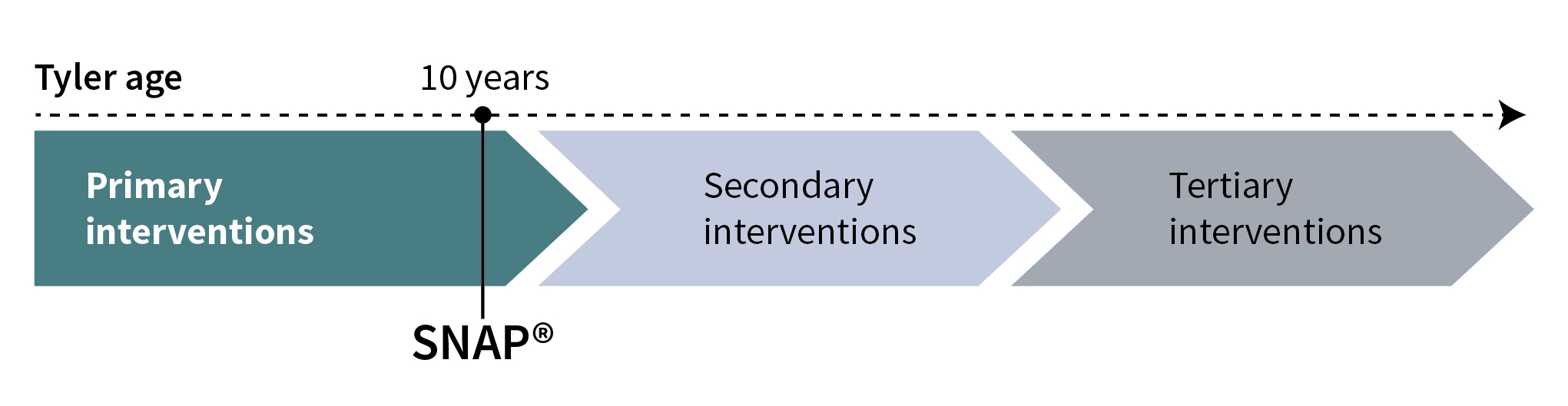
Figure 1: Image description
A timeline diagram showing Tyler's age with three intervention stages. The first stage, labeled 'Primary interventions', is highlighted in teal and spans from birth to 10 years. The second stage, labeled 'Secondary interventions', is highlighted in light blue and follows the primary stage. The third stage, labeled 'Tertiary interventions', is in grey and follows the secondary stage. A vertical line at the 10 year mark indicates the start of SNAP®.
Secondary interventions are used for youth already displaying at-risk behaviours which may escalate to criminal behaviour if unaddressed (such as aggression and association with delinquent peers). Primary and secondary crime prevention approaches focus on early intervention, working to negate the risk of criminal offending before it happens. These interventions may be in the form of safety campaigns such as drug and alcohol prevention programs (Public Safety Canada, 2003; Battams et al., 2021).
Figure 2. Secondary intervention in Tyler's Story
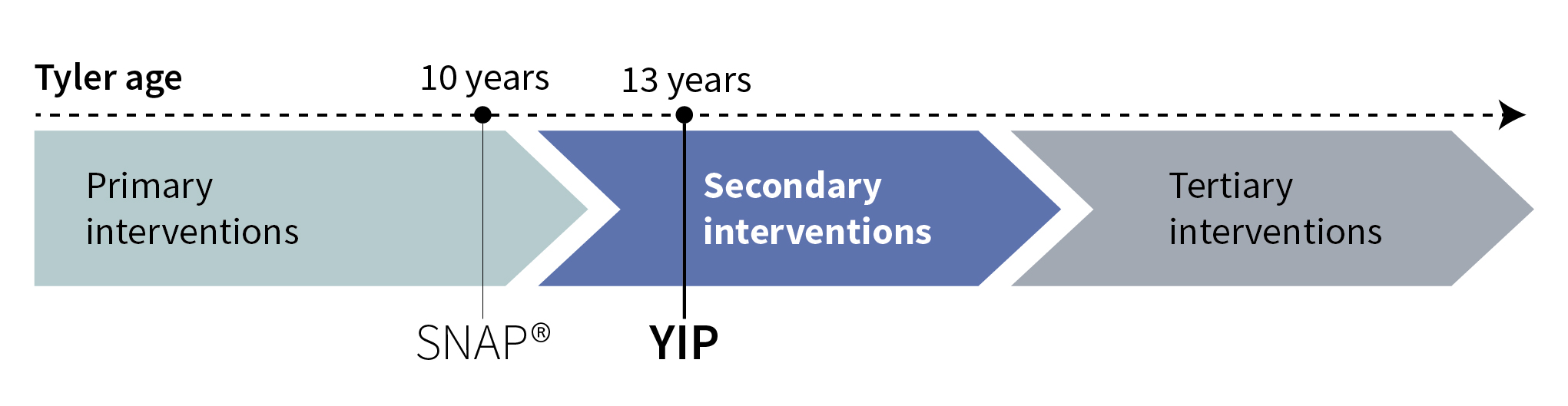
Figure 2: Image description
A timeline diagram showing Tyler's age with three intervention stages. The first stage, labeled 'Primary interventions', is highlighted in teal and spans from birth to 10 years. The second stage, labeled 'Secondary interventions', is highlighted in light blue and follows the primary stage. The third stage, labeled 'Tertiary interventions', is in grey and follows the secondary stage. Key milestones are marked at 10 years for SNAP® and at 13 years for YIP.
Tertiary interventions, however, are implemented after the onset of criminal behaviour. They aim to reduce re-offending by targeting factors with known relationships to offending (including substance use and pro-criminal attitudes) (Public Safety Canada, 2003; Battams et al., 2021).
Figure 3. Tertiary intervention in Tyler's Story
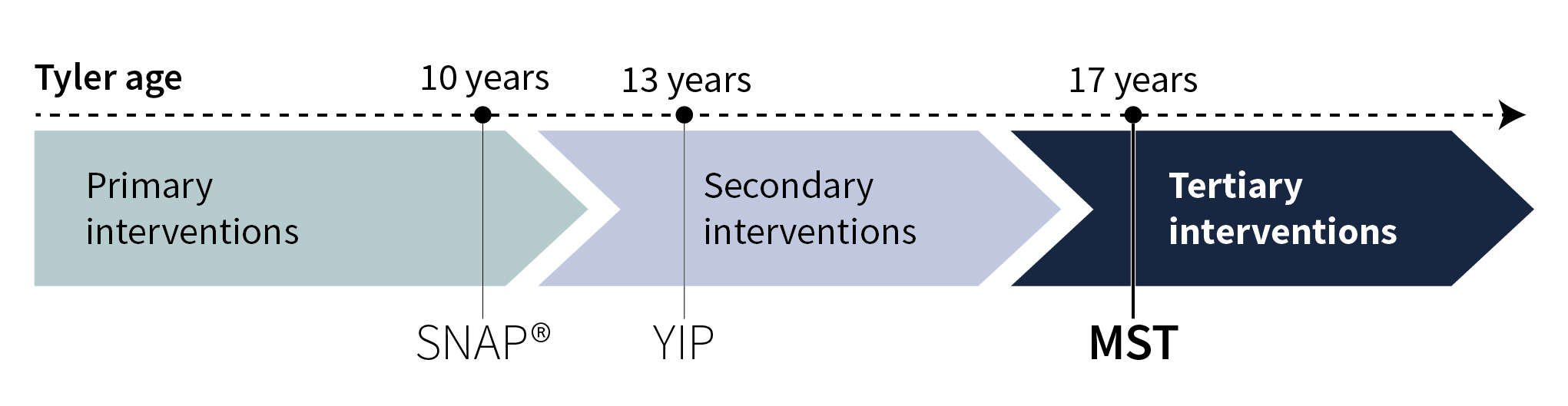
Figure 3: Image description
A timeline diagram showing Tyler's age with three intervention stages. The first stage, labeled 'Primary interventions', is highlighted in teal and spans from birth to 10 years. The second stage, labeled 'Secondary interventions', is highlighted in light blue and follows the primary stage. The third stage, labeled 'Tertiary interventions', is in grey and follows the secondary stage. Key programs are marked at specific ages: SNAP® at age 10, YIP at age 13, and MST at age 17.
Aligning with the three approaches to youth crime prevention, relevant risk factors in Tyler's story are highlighted at each developmental life period to:
- demonstrate how early-life events impact Tyler's development and compound over time,
- identify timeframes where the use of primary and secondary interventions may have mitigated Tyler's risk of criminal behaviour, and
- isolate risk factors to target with tertiary intervention to reduce Tyler's likelihood of re-offending.
Risk factors are also aligned with the three crime prevention programs in the report, illustrating how each of these interventions might mitigate Tyler's risk. This approach is especially important for understanding how these interventions support youth like Tyler who are at risk of continued criminal behaviour and justice involvement.
Risk factors
Risk factors are negative influences in the lives of individuals or their community that can increase one's likelihood of criminal behaviour (Public Safety Canada, 2015). Risk factors for criminal involvement have been conceptualized differently in academic literature, depending on the theoretical framework of focus.
Tyler's story reflects the progression of developmental factors and life course events which contribute to his later offending behaviours. To better understand this progression, Farrington's Integrated Cognitive Antisocial Potential (ICAP) Theory was used to showcase how family background, social environment, and individual-level factors may explain the onset of criminal behaviour (Farrington, 2019).
The ICAP theory differentiates between early-life risk factors (long-term vulnerabilities increasing risk over time) and situational risk factors (short-term triggers increasing immediate risk), suggesting that a combination of these elements increases the likelihood of criminal behaviour (Farrington, 2019).
Early-life risk factors that are slow-changing depend largely on impulsiveness and the process of modeling and socialization such as having criminal family members or peers (Farrington, 2019). By contrast, situational risk factors are quick-changing and depend on motivation and situational influences such as being bored, angry, or the availability of victims (Farrington, 2019). To illustrate:
Early-life (long-term) risk factors include:
- Neglectful and abusive parenting
- Financial instability
- Low school achievement
- Association with delinquent peers
Situational (short-term) risk factors include:
- Lack of supervision
- Alcohol/substance use
- Peer pressure
- Impulsivity
Recent findings from a systematic review have further supported Farrington's ICAP theory, highlighting how early-life and situational factors can work concurrently to increase risk of later offending (Ayano et al., 2024). These risk factors, if identified in early-life, may be resolved with early intervention (for example, primary or secondary interventions) that circumvent criminal behaviour altogether. However, once an individual engages in criminal behaviour, tertiary crime prevention strategies are needed to reduce the likelihood of re-offending.
Tyler's early-life experiences highlight several risk factors outlined in Farrington's ICAP theory, including: financial instability; exposure to physical, psychological, and emotional violence in the home; parental criminal behaviour; neglect; and inconsistent caregiving. His father's incarceration and subsequent absence are examples of long-term risk factors, disrupting Tyler's sense of security and attachments to the primary adults in his life. In contrast, Tyler's early aggressive behaviour, lack of supervision, and impulsivity are examples of short-term risk factors. Moreover, Tyler's unaddressed learning disability and his attention deficit hyperactivity disorder (ADHD), coupled with emotional neglect from his father, exacerbated his difficulties in forming friendships and managing his behaviour, leading to repeated conflicts at school and eventual suspension. Such combinations of long-term and short-term risk factors establish the context for Tyler's pathway towards eventual criminal justice involvement.
Tyler's adolescence was also marked by several long-term and short-term risk factors, including an absence of positive role models, lack of attachment to the primary adults in his life, association with delinquent peers, and substance abuse. Additionally, Tyler's declining school performance and absenteeism contributed to his criminal behaviour; his involvement in petty crimes and vandalism escalated to more serious offences like theft of auto parts and property damage. The lack of non-criminal opportunities for financial stability and insufficient support systems made it difficult for Tyler to break away from his delinquent peers, leading to his chronic involvement with the justice system.
Aligning with the onset of criminal behaviour, Tyler's story transitions to a criminological framework of offending to better understand the risk factors involved. By adopting a criminological perspective centered on criminogenic risk factors, it allows for a more precise identification of key areas to target in treatment and intervention efforts. The "Central Eight" model – an evidence-based rehabilitative model within Bonta and Andrew's General Personality and Cognitive Social Learning (GPCSL) theory – outlines eight broad risk factors that have demonstrated the strongest relationship to recurring criminal behaviour (Andrews et al., 1990; Andrews et al., 2006; Bonta and Andrews, 2024). The Central Eight risk factors are summarized as:
- Antisocial history: early age at first offence, previous charges, incarcerations, weak self-control, pleasure seeking
- Personality: aggression, anger, impulsivity, and poor emotional regulation
- Attitudes/Cognitions: attitudes supportive of crime; criminally-oriented thinking
- Peers/Associates: close association with antisocial and/or criminal peers; social support for crime
- Family: disruption in the home, inconsistent parental supervision, adverse childhood experiences (like neglect and abuse)
- Education/Employment: low levels of performance and engagement in school and/or work
- Leisure/Recreation: inappropriate use of "free time" (for example, lack of structured activities, lack of positive recreational activities or hobbies, using "free time" to engage in delinquency and/or crime)
- Substance use: misuse of alcohol and/or other drugs
Tyler's story transitions methodologically from the ICAP theory in late childhood to the Central Eight model when he reaches his teen years, reflecting the evolution of at-risk behaviours in early life to the onset of his criminal behaviours. Tyler's later adolescence and early adult years reveal several risk factors, including association with delinquent peers, substance use, lack of extracurricular activities, and frequent school absences. His involvement in petty crimes escalated to more serious offences, such as theft, assault, and drug trafficking. Tyler's exposure to more hardened individuals during incarceration further entrenched his criminal behaviour. The stigma of his criminal record and difficulty finding employment led to isolation and continued criminal activity. Additionally, his volatile relationships and domestic violence incidents contributed to his persistent involvement with the justice system. By the age of 30, Tyler had spent over a decade in custody, highlighting the cumulative impact of these risk factors on his life trajectory.
Taken together, and as demonstrated in Tyler's Story, the risk factors showcased in Farrington's ICAP theory and Bonta and Andrews "Central Eight" theory, show considerable overlap. They can be used together to offer a holistic representation of risk. While not exhaustive, the inter-relatedness of these risk factors demonstrate "why" and "how" Tyler's life trajectory resulted in a criminal justice-involvement, and identify a number of risk factors that can be targeted through crime prevention reduction programs.
Strengths and protective factors
Strengths is a general term referring to positive aspects of a person's life. Protective factors, in turn, are specific strengths that can reduce the likelihood of criminal behaviour (or continued criminal behaviour) by counterbalancing and reducing a person's overall level of risk (Jones et al., 2016). Examples can be internal (like positive coping skills) or external (such as having a strong and prosocial support network).
This report acknowledges the critical importance of protective factors in understanding and reducing the risk of criminal behaviour among youth. If a youth has a large collection of risk factors but many protective factors, that youth's risk of negative outcomes is reduced. This report does not identify the protective factors in Tyler's life because the primary focus of Tyler's Story is to illustrate the overwhelming burden of many risk factors and the associated costs. As such, the focus is on risk factors by design.
Costing calculus
Tyler's experiences are used to highlight the most common risk factors that affect Canadian youth who become involved in crime. His story also provides a picture of the potential costs associated with these experiences, ranging from the cost of an emergency room visit to the cost of a federal prison sentence.
Costing rationale
Tyler represents a justice-involved youth in Canada. The report reflects one of many possible outcomes commonly experienced by justice-involved youth. It also highlights the costs associated with Tyler's experiences to support a better understanding of the economic impacts of crime on the Canadian socioeconomic system, and potential cost saving opportunities.
Understanding the economic impacts of crime allows researchers to evaluate the cost-benefit ratios of crime prevention programs. It also supports policymakers in making informed decisions about resource allocation.
Putting a dollar figure on the costs of crime provides a metric to compare the financial burden of criminal involvement to the investment in crime prevention programming.
The cost estimates considered in Tyler's story included only the tangible (direct) costs of crime, including criminal justice, health care, and social services costs. The intangible (indirect) costs due to pain and suffering, decreased quality of life, and psychological distress were not included in the estimates due to a lack of available data. All figures were, at best, an underestimation of the true costs of crime to government and society.
The tangible costs associated with Tyler's story were:
- Criminal justice system costs: costs of delivering police services, court services, prosecution services, legal aid and correctional services, and Criminal Code Review Boards.Footnote 3
- Social services and medical costs: operating costs of social services, foster care, special education, psychological services, and medical costs.
In addition, this report also calculated the participant cost for three interventions to illustrate potential cost savings by investing in crime prevention programs at critical points in Tyler's life. These interventions include Stop Now And Plan (SNAP®), the Youth Inclusion Program (YIP), and Multisystemic therapy (MST).
Costing method
A search of the Crime Prevention Inventory (CPI) – a database of programs funded under the National Crime Prevention Strategy (NCPS) – was conducted to identify funded programs that had been evaluated, and which included a cost per participant. The initial search revealed 13 records for SNAP® and 14 records for YIP that were funded by Public Safety Canada between 2008 and 2019. Of those records, 5 SNAP® interventions and 5 YIP interventions included cost per participant data. This report used the available data in these records to calculate the average cost per participant for SNAP® and YIP. The average cost of YIP was calculated based on 4 out of the 5 available interventions; the excluded intervention was deemed an outlier because its cost per participant was approximately half the value of the 4 other interventions. There were 0 records for MST. As a result, the cost per participant for MST was based on a cost analysis from the Final Evaluation Summary of the Multisystemic Therapy Program (2015), published by Public Safety Canada.
The results of the CPI search were validated by an additional search through program administrative data in the Public Safety Information Management System (PSIMS). No additional results were found.
After adjusting for inflation, the estimated average participant costs of the interventions were:
- $20,615 for SNAP®
- $9,519 for YIP
- $29,745 for MST
Calculations and assumptions
Costing exercise
This report used an accounting-style costing methodology to calculate the costs of Tyler's experiences. This approach is consistent with the Treasury Board of Canada Secretariat's Guide to costing tool. Criminogenic events, child protection services, educational supports, and other prototypical incidents in Tyler's youth were ascribed costs in 2025 Canadian dollars.
To estimate these individual story element costs, the report used a technique that adjusted data from similar past studies to fit Tyler's situation, considering factors like how long, severe, or frequent each cost element was. Where similar costs were not available, new ones were obtained by researching the costs of a story element or by contacting experts in the field (for instance, school administrators, children's service workers, and psychological service providers). To avoid extreme values, the report used conservative estimates. Whenever possible, data were taken from Canadian sources, and the most recent data were prioritized.
The report estimated the cost of delivering police services, court services, prosecution services, and Criminal Code Review Boards. It also estimated costs related to correctional services and offence types for youth and adults, respectively. These included violent crimes, property crimes, auto theft, drug offences, and other Criminal Code offences. The potential costs associated with Tyler's custodial sentences accounted for his expected criminal justice system trajectory, including but not limited to, factors such as security classification, type and duration of custody, and release into the community. Time served in remand and presentence were assumed in the overall sentence time. Tyler's expected trajectory reflected available data on average incarceration experiences in Canada.
Cost-benefit analysis
Using the tangible costs associated with Tyler's story and the participant costs of the interventions, a cost-benefit analysis (Jayaratne, 2013; McIntosh and Li, 2012; Stobierski, 2013) estimated potential cost savings had interventions been delivered at various life periods in Tyler's story. The analysis was done in three steps:
- Estimated cost for each life period: The proposed interventions in Tyler's story would have happened at three life periods: ages 10, 13, and 17. The estimated costs that Tyler would have incurred at each of these life periods were calculated by finding the sum of all costs (including Tyler's direct criminal justice system, social services, and medical costs) in his life up until that point in the story.
- Calculated costs saved: The costs saved represents the costs that would have likely been saved after each life period if he had not undergone an intervention, minus the cost of the intervention itself. For example, if Tyler had participated in SNAP® at age 10, the costs saved would include all expenses that occurred after age 10 in his story, minus the cost of SNAP®. The costs saved with each intervention was estimated with the following formula, where j represents the life period (like age) during which Tyler could have undergone the intervention, and where i represents the type of intervention (for example, SNAP®, YIP, or MST):
Costs saved = sum of Tyler's expenses after j life period – the cost of i intervention
- Determining cost-benefit ratio: a cost-benefit ratio was calculated to represent the amount saved given every dollar spent on an intervention for Tyler. To this end, the sum of the costs Tyler would have incurred after j life period if he had not undergone an intervention was divided by the cost of i intervention. The formula is as follows:
Cost-benefit ratio = sum of Tyler's expenses after j life period / cost of the i intervention
A cost-benefit ratio can indicate a gain, a loss, or equality. A ratio of 1 indicates that the costs and benefits are equal. A ratio greater than 1 indicates that the benefits exceed the costs, while a ratio less than 1 shows that the costs exceed the benefits.
Inflation calculations
All costs (such as crime costs and intervention costs) were adjusted to 2025 Canadian dollars (as of April 2025) using the Bank of Canada Inflation Calculator. This calculator used monthly consumer price index data from 1914 to the present to show changes in the cost of a fixed "basket" of consumer purchases. This report acknowledges that the consumer price index is not a true cost-of-living index and is therefore subject to measurement bias.
Limits
Data limitations
Data limitations are the greatest challenge in costing studies (Li, 2023). A lack of publicly-available data across topics and jurisdictions limits the possibilities and accuracy of the cost calculus. For example, although national estimates are produced where possible, in some cases data were not available for all provinces and territories.
One limitation of the report is the absence of current research on specific costing elements. Examples of these costing elements include offence types (for example, theft under $5,000, damage to property), police calls for service, and courts data (like appearances).
While the cost-benefit analyses may have shown greater savings for one intervention over another (such as YIP over MST), these are best-case scenario estimates that assume the intervention was completely effective and Tyler ceased any future criminal behaviour after treatment. In reality, it is possible that the program would not be entirely effective, and that Tyler might continue some of his criminal activity after the intervention.
Evaluations of these programs that assess delinquency and criminal behaviour before and after the intervention have been implemented, comparing changes in criminal behaviour with changes observed from other types of interventions. This research has demonstrated that these interventions decrease the number of youth that engage in further criminal behaviour after the intervention. Yet there is almost always a portion of the intervention participants that continue their criminal involvement after the intervention (Burke and Loeber, 2016; Laliberte, 2015; Public Safety Canada, 2021; van der Stouwe et al., 2014). Therefore, these cost-saving estimates only offer a best-case scenario illustration of the potential cost savings if Tyler had received the appropriate and effective intervention and ceased any further criminal behaviour.
Intangible costs of crime
As noted earlier, the intangible costs of crime, such as emotional distress and loss of quality of life, are excluded from this iteration of Tyler's Story. This is largely due to the challenges in accurately measuring these subjective elements. The inconsistency in estimates and the complexity they add to the analysis can lead to unreliable results. By focusing on tangible costs, the report ensures more clarity and actionable insights for policymakers.
Conclusion
In summary, this methodological companion document provides detailed insights into the guiding frameworks, key assumptions, and calculations that inform Tyler's Story. By further examining the inter-relatedness of developmental and criminogenic risk factors in the onset of criminal behaviour and treatment, this companion enhances the reader's understanding of "why" and "how" youth in Canada may become justice-involved. Additionally, by elaborating on the cost of crime analysis, it highlights the financial implications of criminal behaviour overall. This companion document, and the Tyler's Story report, contributes to the larger conversation about the value of investments in early and effective crime prevention programs for at-risk youth.
Annex A: Cost Estimates
Line Item |
Total Calculated Cost (in 2025 Canadian Dollars) |
|---|---|
Police Call for Service |
$176 |
Child and Family Services Investigation |
$7,809 |
Child Services Home Visits |
$57,656 |
Period Total |
$65,641 |
Line Item |
Total Calculated Cost (in 2025 Canadian Dollars) |
|---|---|
Emergency Room Visit |
$1,083 |
Child and Family Services Investigation |
$7,809 |
Child Custody Hearing ($14,558.09 for a duration of 5 days) |
$72,790 |
Foster Care ($1,530.57 per month for children under the age of 11) |
$12,245 |
Period Total |
$93,927 |
Line Item |
Total Calculated Cost (in 2025 Canadian Dollars) |
|---|---|
Parenting Classes |
$3,198 |
Supervised Access ($30.00 per visit, 2 times per week for 8 weeks) |
$480 |
Child Services Home Visits/Ongoing Casework ($57,655.85 per year for 2 years) |
$115,312 |
Psychoeducational Assessment |
$4,497 |
Individual Education Plan ($6,189.16 per year for 3 years) |
$18,567 |
Period Total |
$142,054 |
Line Item |
Total Calculated Cost (in 2025 Canadian Dollars) |
|---|---|
Individual Education Plan ($6,189.16 per year for 4 years) |
$24,757 |
Police Call for Service |
$176 |
Arrest of a Juvenile |
$677 |
Youth Court Appearance ($1,650.83 per appearance for 2 appearances) |
$3,302 |
Police Attendance at Court ($443.10 per attendance for 2 attendances) |
$886 |
Theft Under $5,000 |
$1,542 |
Damage to Property |
$3,470 |
Probation Supervision ($23.21 per day for 90 days) |
$2,089 |
Community Service Supervision ($114.41 per day for 50 hours in 6.25 work days of 8 hours in length |
$715 |
Period Total |
$37,614 |
Line Item |
Total Calculated Cost (in 2025 Canadian Dollars) |
|---|---|
Individual Education Plan ($6,189 per year for 3 years) |
$18,567 |
Police Call for Service ($176 per call for 2 calls) |
$351 |
Social Assistance for High School Drop Out ($765.81 per month for a total of 48 months between the ages of 17 and 30 |
$36,759 |
Arrest of a Juvenile ($677.08 per arrest for 2 arrests) |
$1,354 |
Youth Court Appearance ($1,650.83 per appearance for 2 appearances) |
$3,302 |
Police Attendance at Court ($443.10 per attendance for 3 attendances) |
$1,329 |
Probation Supervision ($23.21 per day for 240 days) |
$5,570 |
Assault ($5,718.14 per assault for 2 assaults) |
$11,436 |
Youth Custody Facility ($253.12 per day for 120 days) |
$30,374 |
Period Total |
$109,044 |
Line Item |
Total Calculated Cost (in 2025 Canadian Dollars) |
|---|---|
Police Call for Service ($175.62 per call for 3 calls) |
$527 |
Arrest of Adult ($3,205.54 per arrest for 3 arrests) |
$9,617 |
Adult Court Appearance ($8,987.04 per appearance for 4 appearances) |
$35,948 |
Police Attendance at Court ($443.10 per attendance for 4 attendances) |
$1,772 |
Drug Offence/Investigation ($3,861.85 per offence/intent to traffic for 2 offences/intent to traffic) |
$7,724 |
Provincial Custody ($340.59 per day for 1,030 days) |
$350,808 |
Probation Supervision ($23.21 per day for 12,130 days) |
$281,537 |
Assault ($5,718.14 per assault for 2 assaults) |
$11,436 |
Aggravated Assault |
$20,097 |
Assault Causing Bodily Harm |
$20,097 |
Uttering Threats |
$5,087 |
Federal Prison ($447.16 per day for 850 days) |
$380,086 |
Period Total |
$1,124,738 |
Annex B: Cost Elements
Line Item |
Costs (in 2025 Canadian Dollars) |
Description and source |
|---|---|---|
Police Call for Service |
$175.62 |
Calculated based on the 2024 estimated property cost ($348) from the Ontario Provincial Police (OPP) municipal policing cost comparison chart (Ontario Provincial Police, 2025), multiple by the proportion of municipal workload in detachments accounted for by calls for service in 2024. Therefore, the cost of a Police Call for Service was 348*0.496 = $172.62 (per call) in 2024. |
Child and Family Services Investigation |
$7,809.37 |
Calculated by adding the 2024 cost of non-case services ($844,316), case services ($289,115), and salaries ($32,861,589) from the Children's Aid Society of Ottawa (2024a), and then dividing by the number of child protection assessments in 2023/2024 (4,429). This resulted in a cost of $7,675.55 in 2024. |
Child Services Home Visits |
$57,655.85 |
Calculated by adding the 2024 cost of case services ($289,115) and salaries ($32,861,589) from the Children's Aid Society of Ottawa (2024b), and dividing the sum by the number of ongoing protection cases (585). This resulted in a cost of $56,667.87 in 2024. |
Emergency Room Visit |
$1083.12 |
The cost for an emergency room visit at the Queensway Carleton Hospital in 2021 was $930.00 for non-residents of Canada – of which the non-resident fees reflect the unsubsidized, real visit costs. |
Child Custody Hearing |
$14,558.09 |
The cost was determined by estimating the median cost for the median length of a trial based on the costs and trial lengths of several sources. Footnote 4 This resulted in a median cost value per day of trial of $12,500 in 2021. This cost estimate relates only to the cost of preparation for an attendance at the trial itself. It does not include the costs of commencing an action, attending the case conference, examinations for discovery, document disclosure, interim applications, the cost of disbursement or taxes. Regarding auxiliary costs, they are estimated to range from $500.00 to $5,000.00 or more (Lemieux Litigation, 2018). Similarly, the costs for a Motion can range from $1,000.00 to $20,000.00 (Lemieux Litigation, 2018). |
Foster Care |
$1,530.57 |
British Columbia legislation in 2023 was tabled by the Child and Family Development Minister to offer payment to foster parents of $1,465 per child per month (The Canadian Press, 2023). |
Parenting Classes |
$600.00 |
These parenting classes incorporated parenting lessons, anger management training, and mental health counselling. To estimate the cost of this work, the cost of an anger management course by Family Services Ottawa (2025) for two persons. |
Supervised Access |
$30.00 |
The Family Services Ottawa (2025) supervised access program had a cost of $30.00 per visit |
Psychoeducational Assessment |
$4,497.06 |
The Canadian Centre of Integrative Psychology & Healthcare (CCIPH; 2024) estimated that the cost for a psychoeducational assessment for youth with ADHD ranged from $3,000 to $5,840. The median of this range was used as the unit of cost in Tyler's Story, valued at $4,420 in 2024. |
Individual Education Plan |
$6,189.16 |
The costs were obtained from the Government of Canada (2024) job bank and the Ontario Ministry of Education (2023). It incorporated partial salary costs for education personnel responsible for Tyler, assistive technology, and adaptive software. The partial salary costs were estimated for a special education elementary school teacher (median wage of $46.15), an education assistant (median wage of $25.00), and an education counsellor (median wage of $40.02) – assuming a class size of 30 and an estimated 3.33% of their time dedicated to a single student (i.e., Tyler). The percentage was applied to the full-time yearly salaries for a 36-week school year for a total of $5,283.10 (in 2024 dollars; equals.033*$160,093.80). In terms of technology and adaptive software, Tyler would receive a Google Chromebook with speech-to-text software, which would be covered by an $800 stipend provided by the school board, while the remaining $5,283.10 would be covered by the Government of Ontario's Special Equipment Amount. In total, the cost for a year of Tyler's individual education plan was estimated to be $6,083.10 in 2024. |
Arrest of a Juvenile |
$677.08 |
This cost was the average cost of arrests under the Youth Criminal Justice Act (2003) by the Waterloo Regional Police Service, acquired from a Public Safety Canada report (Elligwood, 2015). The cost was averaged at $508.43 in 2013. |
Youth Court Appearance |
$1,650.83 |
The cost per youth court appearance was estimated at $1,275.00 in 2015 by the Government of Alberta's (2015) Safe Communities Innovation Fund pilot project. |
Police Attendance at Court |
$443.10 |
The cost was estimated using Ottawa Police Services (2025) 2023 cost for a tier 2 constable attending court for a required minimum of four hours. In 2023, this cost was calculated as $424.12 per court appearance. |
Theft Under $5,000 |
$1,542.09 |
An early report (Gabor, 2016) estimated the cost per theft incident in 2014 to the criminal justice system to be $1,181.58. |
Damage to Property |
$3,469.73 |
An early report (Gabor, 2016) estimated the cost per property damage incident in 2014 to the criminal justice system to be $2,658.57. |
Probation Supervision |
$23.21 |
An early report (Day et al., 2016) estimated the per-diem cost for probation supervision in 2013 to be $17.43. |
Community Service Supervision |
$114.41 |
An early report (Day et al., 2016) estimated the per-diem (8-hour) cost for community service supervision in 2014 to be $87.66. |
Social Assistance for High School Drop Out |
$765.81 |
The cost was determined from the Ontario Works financial assistance payments for a single individual who had not completed high school. The cost was $733.00 per individual per month in 2023 (Income Security Advocacy Centre, 2023). |
Assault |
$5,718.14 |
An early report (Gabor, 2016) estimated the cost per assault in 2014 to the criminal justice system to be $4,381.34. |
Youth Custody Facility |
$253.12 |
The cost was determined by the Office of the Parliamentary Budget Officer (2018). The specific cost per day in 2016-17 per youth was $202.00. |
Arrest of Adult |
$3,205.54 |
An early report (Gabor, 2016) estimated the cost per arrest of an adult in 2014 to the criminal justice system to be $2,456.14. |
Adult Court Appearance |
$8,987.04 |
An early report (Gabor, 2016) estimated the cost per adult court appearance in 2014 to the criminal justice system to be $6,886.03. |
Drug Offence/Investigation |
$3,861.85 |
An early report (Ellingwood, 2015) estimated the cost per drug offence/investigation in 2013, which combined the costs for possession and trafficking of cocaine from the Uniform Crime Reporting Survey, to be $2,889.93 per offence/investigation. |
Provincial Custody |
$340.59 |
The cost was determined according to the Corrections Key Indicator Report for Adults (Statistics Canada, 2024). It constitutes the average daily estimated cost across provinces and territories derived from institutional operating costs and the number of individuals in custody in 2023, which was estimated at $326.00 per day. |
Aggravated Assault |
$20,097.31 |
An early report (Gabor, 2016) estimated the cost per aggravated assault in 2014 to the criminal justice system to be $15,398.92. |
Assault Causing Bodily Harm |
$20,097.31 |
An early report (Gabor, 2016) estimated the cost per assault causing bodily harm in 2014 to the criminal justice system to be $15,398.31. |
Uttering Threats |
$5,087.17 |
Uttering threats is a criminal offence according to the Canadian Criminal Code (1985) section 264.1(1)(a) and is punishable by a fine up to $5000.00 or a term of incarceration of two years less a day (Caramanna Friedberg, 2024). |
Federal Prison |
$447.16 |
The cost was determined according to the Corrections Key Indicator Report for Adults (Statistics Canada, 2024). It is derived from institutional operating costs and the number of individuals in custody in 2023, which was estimated at $428.00 per day. |
References
Andrews, D. A., Bonta, J., and Wormith, J. S. (2006). The Recent Past and Near Future of Risk and/or Need Assessment. Crime and Delinquency, 52(1), 7-27.
Andrews, D. A., Zinger, I., Hoge, R. D., Bonta, J., Gendreau, P., and Cullen, F. T. (1990). Does Correctional Treatment Work? A Clinically Relevant and Psychologically Informed Meta-Analysis. Criminology, 28, 369.
Battams, S., Delany-Crowe, T., Fisher, M., Wright, L., Krieg, A., McDermott, D. and Baum, F. (2021). Applying Crime Prevention and Health Promotion Frameworks to the Problem of High Incarceration Rates for Aboriginal and Torres Strait Islander Populations: Lessons from a Case Study from Victoria. The International Indigenous Policy Journal, 12(2), 1–29.
Bonta, J. and Andrews, D.A. (2024). The Psychology of Criminal Conduct (7th ed.). New York, NY: Routledge.
Canadian Centre of Integrative Psychology & Healthcare (2025). Ontario fees.
Canadian Press. (2023, March 29). B.C. increases monthly payments to foster care families.
Caramanna Friedberg (2024). Uttering Threats Lawyer Toronto.
Children's Aid Society of Ottawa (2024). Annual Report 2023/24.
CoParenter (2022). How much does a custody battle cost?
Criminal Code of Canada, R.S.C. (1985, c-46).
Day, D. M., Koegl, C. J., Rossman, L., & Oziel, S. (2015). The monetary cost of criminal trajectories for an Ontario sample of offenders. Public Safety Canada, R011.
Ellingwood, H. (2015). A better estimation of police costs by offence types. Public Safety Canada, R-018.
Family Services Ottawa (n.d.). Anger management… Especially for parents.
Farrington, D. (2019). The Integrated Cognitive Antisocial Potential (ICAP) Thepry: Past, Present, and Future. Journal of Developmental and Life-Course Criminology, 6 (2).
Gabor, T. (2015). Costs of crime and criminal justice responses. Public Safety Canada, R022.
Gallo A, Belanger M, Abracen J, Looman J, Picheca J, et al. (2014) Treatment of High-Risk High-Need Sexual Offenders: The Integrated Risk Need Responsivity Model (RNR-I). Ann Psychiatry Ment Health 3(1): 1018.
Government of Alberta (2015). Safe Communities Innovation Fund Pilot Project Executive Summaries: Individual summaries written by Alberta community crime prevention organizations.
Government of Canada (2024). Job bank: Special Education teaching – Elementary School in Ontario.
Government of Ontario Ministry of Education (2023). Special Education funding guidelines: Special Equipment Amount (SEA), 2023-24.
Income Security and Advocacy Centre (2023). OW & ODSP Rates and the Ontario Child Benefit: Current to July 2023.
Jayaratne, K.S.U. (2013, April). Learn how to analyze cost-benefits of extension programming. North Carolina State University and AandT State University Cooperative Extension.
Jones, N. J., Brown, S. L., Robinson, D., and Frey, D. (2016). Validity of the youth assessment and screening instrument: A juvenile justice tool incorporating risks, needs, and strengths. Law and Human Behaviour, 40(2), 182–194.
Law for Families (2018). The average cost of child custody.
Lemieux Litigation (2021). How much does a family lawyer cost?
Li, Ting. (2023). Costs of crime in Canada, 2014. Department of Justice Canada.
McIntosh, C. & Li, J. (2012). An introduction to economic analysis in crime prevention: The why, how and so what. Public Safety Canada.
Office of the Parliamentary Budget Officer (2018). Update on costs of incarceration.
Ontario Provincial Police (2024). 2015-2024 Cost by municipality.
Ottawa Police Services. (2025). Paid Duty and Events.
Polaschek, D. L. L. (2012). An appraisal of the risk-need-responsivity (RNR) model of offender rehabilitation and its application in correctional treatment. Legal and Criminological Psychology, 17(1), 1-17. doi:10.1111/j.2044-8333.2011.02038.x
Public Safety Canada. (2003). Approaches to understanding crime prevention.
Public Safety Canada. (2015). Risk and protective factors.
Queensway Carleton Hospital (2021). Uninsured and non-resident fees.
Statistics Canada. (2024). Table 35-10-0013-01: Operating expenditures for adult correctional services.
Stobierki, T. (2019, September 5th). What is a cost-benefit analysis and how to do it. Harvard Business School Online.
West Coast ADR Law Group (2024). Comparison of costs.
Yousefi, L. (2016). How much do family law trials cost? YLAW.
- Date modified: